
How to Eat Vietnamese Food Like a Local: A Beginner’s Guide to Vietnamese Most Popular Dishes

Vietnamese food follows a few shared principles: chopsticks are standard, the table almost always includes a variety of condiments (fish sauce, fresh chilli, coriander, lime) so each diner can season to taste, and most meals are eaten communally from shared dishes. Beyond these general habits, each dish has its own ritual - from mixing the broth of a pho bowl to pouring sauce into a bun bo before the first bite.
Read on for a dish-by-dish breakdown.

How Vietnamese People Typically Eat Their Meals
Before getting into individual dishes, a few principles apply across almost all Vietnamese meals.
Firstly, dishes arrive gradually and settle at the centre of the table. Bowls of rice, soups, braised meats, stir-fried vegetables are meant to be shared among everyone present.
Condiments and herbs are part of the dish, not an afterthought. A small bowl of fish sauce (with lime, sugar, chilli, and sometimes garlic) sits at the centre of most Vietnamese tables. So do sliced fresh chilli, lime wedges, and a plate of fresh herbs. Vietnamese cuisine invites diners to participate in shaping the final flavour of a dish: the kitchen provides the foundation, while each person adjusts and balances it according to their own taste.
Chopsticks, too, are used with a quiet sense of consideration. In shared meals, it is common to pick up food from communal plates and place it into your own bowl, or occasionally into someone else's as a gesture of hospitality. Chopsticks should never be left standing upright in a bowl of rice, as the resemblance to incense sticks used in ancestral offerings makes it an unwelcome image at the dining table.
Beyond a few such customs, there is little formality involved. Vietnamese dining is less about following strict etiquette than about eating attentively, sharing generously, and helping everyone at the table feel looked after.

How to Eat Popular Vietnamese Dishes Correctly
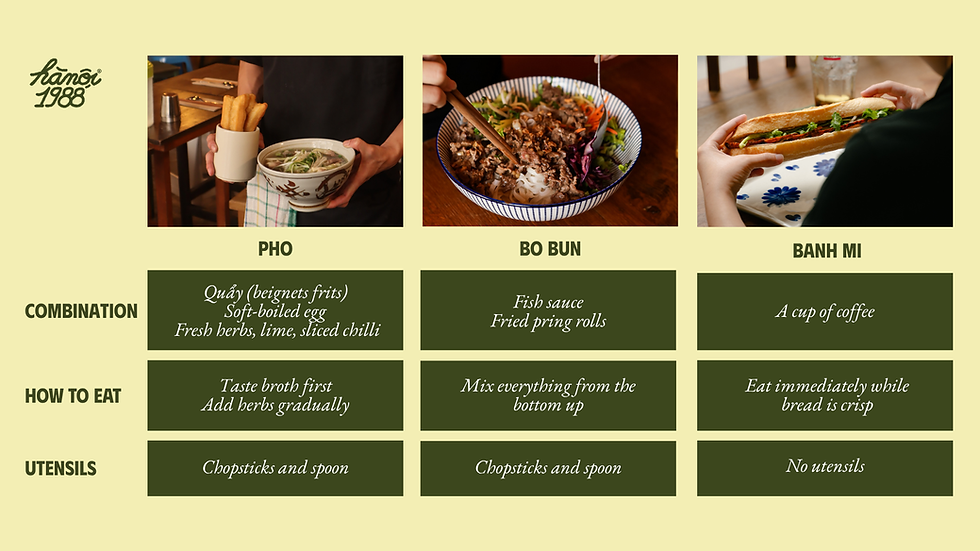
How to Eat Phở
Pho (Vietnamese noodle soup) arrives as a large bowl of clear, slow-cooked broth with rice noodles and your chosen protein (typically beef or chicken), accompanied by a plate of fresh herbs, lime, and sliced chilli on the side.
The most common mistake is adding everything at once. The broth is the centrepiece of the dish; it has been cooked for hours, sometimes longer, and it deserves to be tasted on its own before anything is changed. Take a spoonful of broth first, then begin adding: a squeeze of lime, a leaf of Thai basil, a few bean sprouts. Then you can taste again and adjust.
In Vietnam, many people enjoy it with quẩy (beignets frits - long strips of fried dough) that can be dipped into the broth until slightly softened while still retaining a bit of crunch. Another popular addition is a soft-boiled egg, whose creamy yolk enriches the broth and makes for a more substantial meal.

For the full history and regional variations of pho, see our dedicated guide to pho in Paris.
How to Eat Bo Bun (Bun Bo)
Bo bun, known in Vietnamese as bun bo, is a dry noodle bowl: rice vermicelli served at room temperature, layered with stir-fried beef, fresh vegetables, herbs,... and a homemade dipping sauce served alongside.
Pour the sauce over the bowl and toss gently with chopsticks until the noodles are evenly coated. Each bite should combine vermicelli, grilled meat and vegetables, bringing together contrasting textures and temperatures. If spring rolls are served alongside, save a little sauce for dipping because their crisp shell is best enjoyed with the dressing undiluted.

More on bo bun and its ingredients in our guide to bo bun in Paris.
How to Eat Bánh Mì
Bánh mì is a Vietnamese sandwich served in a light baguette with a thin, crisp crust. It is typically filled with grilled meat, char siu pork or pâté, along with pickled daikon, carrot,... and a smear of butter or mayonnaise.
There is no complicated ritual here. Eat it immediately with your hands, and eat it while the bread is still crisp. It is a street food designed for the moment it is made. Many Vietnamese people also pair bánh mì with a cup of Vietnamese coffee, especially at breakfast or as a quick lunch.

Where to Experience Authentic Vietnamese Dining Culture in Paris
Understanding how to eat Vietnamese food is more satisfying when the food itself is made with care.
At Hanoi 1988, the kitchen follows the culinary tradition of northern Vietnam: 24-hour beef broth for the pho, housemade sauces, and seasonal herbs served at the table rather than measured out in the kitchen. The group operates four addresses in Paris. For those experiencing Vietnamese food for the first time, the flagship at 72 Quai des Orfèvres (75001) offers a broad introduction to the cuisine in a central and accessible setting. Sao Vàng on Île Saint-Louis (16 Rue le Regrattier, 75004) is the more intimate of the two, designed after the neighbourhood shops of 1980s Hanoi, and a room that encourages eating slowly.
There are no strict rules when eating Vietnamese food, preferences and small rituals passed from one table to the next. If you'd like to experience these traditions for yourself, join us at Hanoi 1988, where every meal is an invitation to eat, share and discover Vietnamese cuisine as locals do.

Reserve your table at Hanoi 1988 and begin your journey through Vietnamese food culture.


Comments