
Vietnamese Food Types: The Complete Guide to Vietnam's Culinary Categories
- Luu Quynh Anh
- 2 minutes ago
- 4 min read

Vietnamese cuisine is easiest to understand once it is broken into a handful of clear categories rather than approached dish by dish. Three types cover most of what appears on a Vietnamese table: noodle and vermicelli dishes, rice dishes, street food and snacks. Each category has its own texture, flavor and typical moment in the day, which is why a single cuisine can feel both endlessly varied and quietly consistent.
The Three Main Types of Vietnamese Food

Noodle and Vermicelli Dishes
Noodles are at the heart of Vietnamese cuisine and are enjoyed throughout the day. This is the broadest and most recognised category, split into two families.
Vietnam's famous noodle soups are known for their slow-simmered broths and fresh herbs. These soups showcase the Vietnamese philosophy of balancing sweet, salty, sour, and umami flavors in every bowl. Popular examples include:
Phở - Vietnam's iconic noodle soup featuring rice noodles, aromatic beef or chicken broth, and fresh herbs
Bún Bò Huế (Hue beef noodle soup) - A spicy noodle soup originating from Central Vietnam with a rich, fragrant broth
Bún Riêu (Crab noodle soup) - A tomato-based crab noodle soup with tofu and fresh vegetables.

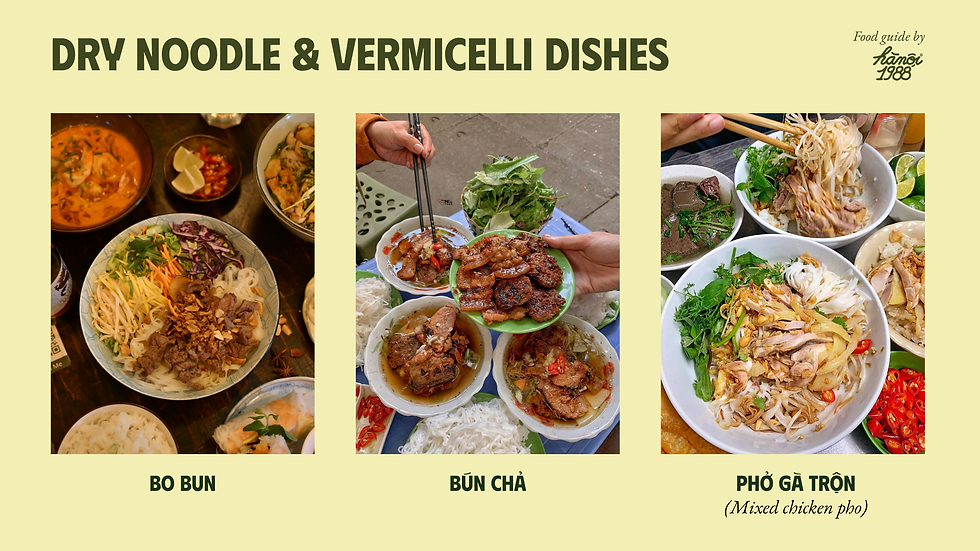
Dry noodle dishes, such as bo bun (bún bò), skip the broth entirely. Vermicelli is tossed at room temperature with stir-fried protein, fresh vegetables, and a sweet-savoury dipping sauce. These dishes are light, flavorful, and perfect for those seeking a refreshing yet satisfying meal.
Bo bun - A refreshing rice vermicelli bowl topped with beef, fresh herbs, pickled vegetables, crushed peanuts, and a flavorful fish sauce dressing.
Bún Chả - A classic Hanoi specialty featuring grilled pork, rice vermicelli, fresh herbs, and a tangy dipping sauce.
Phở gà trộn (Mixed chicken pho) - A dry version of Vietnam's famous pho, made with silky rice noodles tossed in a savory soy sauce and served with tender chicken, fresh herbs, and crisp vegetables.
Both share the same rice-based noodle but land on the plate in almost opposite ways, one warm and brothy, the other cool and dressed.
Rice Dishes
Rice appears in Vietnamese cooking far beyond the bowl of plain steamed rice served alongside other dishes. Cơm tấm, broken rice topped with grilled pork and a fried egg, is a Southern dish built for a fast, satisfying lunch. Cơm rang, Vietnamese fried rice, repurposes leftover rice with egg, vegetables, and often sausage or shrimp. Family-style rice meals go further still, with a shared table of rice, a protein, a vegetable dish, and a light soup, eaten together rather than portioned individually. This communal format is closer to how rice is eaten at home than any single named dish suggests.

Street Food and Snacks
Street food is where Vietnamese cuisine shows its most inventive side. Bánh mì, a baguette filled with pâté, pickled vegetables, and a choice of protein, is the clearest example of French and Vietnamese ingredients meeting on equal terms. Bánh xèo, a crisp turmeric crepe filled with shrimp and bean sprouts, is wrapped in lettuce and herbs before each bite. Summer rolls, translucent rice paper parcels of vermicelli, herbs, and shrimp or pork, are served fresh and uncooked, dipped rather than eaten straight. None of these require a sit-down meal, which is exactly the point.

Vietnamese Food by Meal Time
Breakfast in Vietnam is often built around noodle soups, banh mi or sticky rice, since something warm and filling before the day starts is the norm rather than the exception. Phở, for instance, is as common at seven in the morning as it is at lunch.
Lunch tends to favour noodle bowls and rice plates. This is the meal most likely to be eaten quickly, often seating briefly at a low table at a local food stall near the workplace, which explains why bo bun, cơm tấm, and mixed chicken pho dominate the midday hours.
Dinner slows the pace down and is often the time when family members gather again after a long day of work or school. Many Vietnamese families return home to cook together, share a home-cooked meal, and catch up over conversations around the table. Grilled and stir-fried mains, shared rice meals, and soups take center stage, served across several dishes rather than one bowl. The same ingredients that appear quickly at lunch are given more time and more company in the evening, making dinner not just a meal, but a cherished daily family tradition.
Experience Authentic Vietnamese Food Types at Hanoi 1988
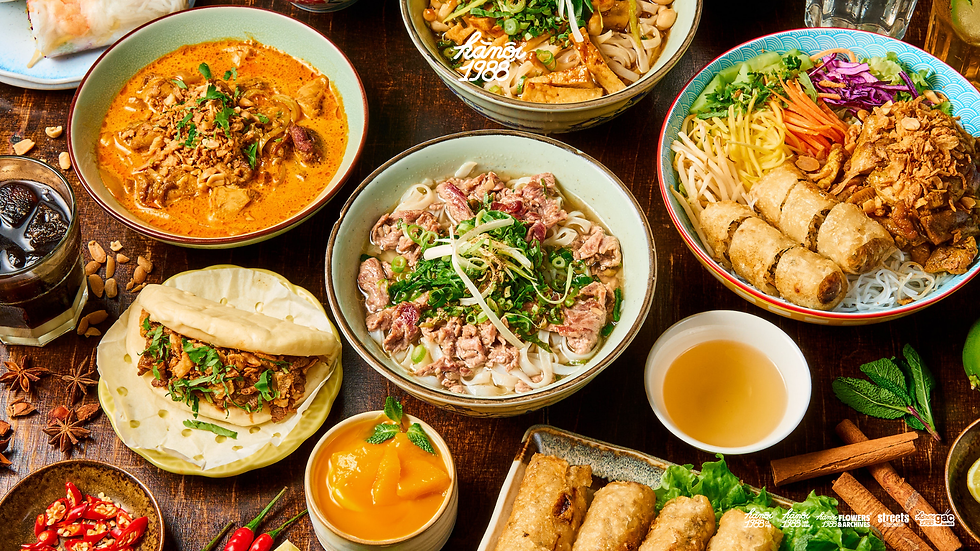
Understanding the categories is one thing. Tasting them side by side is another. At Hanoi 1988's flagship on 72 Quai des Orfèvres, the menu moves across noodle soups, dry noodle bowls, rice, and bánh mì in a single visit, giving newcomers a genuine cross-section of the cuisine rather than one dish in isolation. Phở bò (beef noodle soup) and phở gà (chicken noodle soup) anchor the noodle soup side, while bò bún and fresh spring rolls cover the room-temperature, herb-forward end of the spectrum. At Hanoi 1988 Cà Phê, xôi mặn and a family-style rice plate extend that range further.

Ready to taste the full range of Vietnamese food types in one place? Explore the menu at viet-eat.com.
FAQ
How many main types of Vietnamese food are there? Most of the cuisine falls into three broad categories: noodle and vermicelli dishes, rice dishes, street food and snacks.
What is the difference between a noodle soup and a dry noodle dish? A noodle soup like phở is served hot in broth, while a dry noodle dish like bo bun is served at room temperature, dressed with a sauce instead.
What Vietnamese food type is best for breakfast? Noodle soups and banh mi are the most traditional breakfast choices, since something warm and substantial is preferred before the day begins.


Comments