
The Best Vietnamese Food in Paris - A Guide to Dishes Worth Seeking Out
- Luu Quynh Anh
- 7 days ago
- 8 min read

From flavorful pho, fresh bun bo to crispy spring rolls - discover the best Vietnamese food in Paris and where to find it across our Hanoi 1988 addresses.
Vietnamese cuisine is not a single thing. It is a conversation between north and south, between street and table, between the delicate and the deeply savoury. It changes by region, by season, by the hand that makes it. What holds it together is a shared philosophy: freshness above all, balance in everything, nothing wasted.
In Paris, Vietnamese food has been part of the culinary landscape for decades. But not all of it is made with the same care. The best Vietnamese food in Paris rewards the effort of finding it: a broth that has been cooking since yesterday, noodles made this morning, a sauce built by hand from ingredients that matter.
This is a guide to the dishes that define Vietnamese cuisine at its finest and where, in Paris, to find them.

What Makes Vietnamese Food Worth Knowing
Before the dishes, a word about the principles.
Vietnamese cuisine is one of the few in the world where freshness is not a quality, it is a requirement. Raw herbs are not a garnish; they are an ingredient. The balance of salt, sweet, sour, and heat is not a preference; it is the goal of every sauce, every broth, every dressing. And the contrast of textures - something hot alongside something cool, something crisp alongside something yielding - is deliberate, consistent, and deeply satisfying.
Understanding these principles changes the way you eat Vietnamese food. You stop asking whether a dish is spicy or mild, heavy or light. You start noticing whether the broth has depth, whether the herbs are fresh, whether the sauce achieves that precise state of balance that makes you reach for another bite without quite knowing why.
The best Vietnamese food in Paris offers all of this. Here is where to start.
Phở - The Dish That Demands Patience
Pho is the most widely known Vietnamese dish in the world, and also the most frequently misunderstood. A bowl of pho is not simply noodles in broth. It is the result of a process that cannot be shortened without consequence.

The bones must be cooked for hours - a minimum of six, ideally twelve or more - before the broth achieves the collagen-rich body and layered mineral depth that defines great pho. The aromatics, which are charred ginger and onion, star anise, cinnamon, cloves, are added at specific stages. The noodles are cooked separately and added to order. The toppings - thin-sliced beef, bean sprouts, fresh herbs and lime - arrive at the table and are adjusted by the diner. Pho is the only dish where the cook finishes only half the work.
At Hanoi 1988 Sao Vàng, the broth is simmered for 24 hours. The noodles are made freshly in-house each morning. While this is a detail that most Parisian Vietnamese restaurants do not bother with, it is immediately apparent in the texture of the bowl. The chicken broth is prepared separately from the beef, a refinement that yields something cleaner and more precise than a shared base would allow.
If you have only ever eaten pho made with a powder or a shortcut broth, this bowl will change your expectations.

Phở Sốt Vang - Where Vietnam Meets France
There is one dish on the Hanoi 1988 menu that could only exist in Paris.
Phở Sốt Vang (Vietnamese beef stew) takes the 24-hour pho broth as its base, then adds something unexpected: beef slow-braised in red wine, in the manner of a French boeuf bourguignon. The tender and fragrant wine-braised meat is served in the broth alongside the fresh noodles and aromatics of a traditional pho.

This is not fusion food in the usual sense. Instead, it reflects how Vietnamese cuisine evolved after arriving in France during a particular moment in history. The best Vietnamese cooking embraces local influences while staying true to its original identity. The wine gives the broth a new dimension of depth. The pho framework gives the braised beef a lightness it would not have in a French context.
You will not find this dish at any other Vietnamese restaurant in Paris. It is the clearest expression of what Hanoi 1988 is trying to do: honour the tradition, understand the context, and cook something that could only happen here.
Bun Bo - The Bowl That Rewards Attention
If pho is Vietnamese cuisine at its most meditative, bun bo (or bo bun) is Vietnamese cuisine at its most alive.

A bowl of bun bo is built on rice vermicelli served at room temperature, layered with stir-fried beef, an abundance of fresh vegetables and a pile of mint and coriander that perfumes the entire bowl. Roasted peanuts and fried shallots finish it with crunch and depth. A homemade sauce arrives on the side.
The ritual of mixing everything together is part of the experience. Start with the sauce, then gently fold the ingredients from the bottom of the bowl. What follows is one of the greatest pleasures of Vietnamese food: warm beef paired with cool noodles, crunchy peanuts balanced against soft vermicelli, and fresh herbs bringing brightness to every bite.
At Hanoi 1988, this dish is available in four variations: beef (Bò Bún), chicken (Gà Bún), tiger shrimp (Tôm Bún), and tofu (Bún Chay). Each version is built on the same fresh foundation and finished with the restaurant’s signature housemade sauce.
A tip worth keeping: reserve a little sauce for the spring rolls that arrive alongside. Dip rather than mix. The crispy exterior of the roll and the undiluted sauce deserve each other.
Spring Rolls - The Dish Everyone Orders First
CNN once ranked Vietnamese spring rolls among the 50 best foods in the world. It is not a surprising choice for anyone who has eaten a good one.
The Vietnamese fried spring roll is a study in contrast: a thin rice paper wrapper, hand-rolled and deep-fried until completely crisp, enclosing a filling of pork, shrimp, and fresh vegetables that stays juicy and fragrant inside. The first bite is all crunch; what follows is warm, savoury, and just complex enough to keep you reaching for the next one.

Across Vietnam, the dish goes by different names depending on where you are. In the south, it is chả giò. In the north, nem rán. In the central region, ram. The names differ; the pleasure does not.
At Hanoi 1988, every spring roll is hand-rolled in rice paper and fried to order. They are available at both the Quai des Orfèvres and Sao Vàng addresses, served as a starter or alongside the bun bo bowls. Either way, set aside a little dipping sauce before mixing it into your noodles. The spring rolls earn it.
Bánh Trôi Tàu - A Sweet End to the Meal
Vietnamese cuisine rarely finishes with dessert in the Western sense. But Bánh Trôi Tàu comes close to changing that.
These are small glutinous rice balls, soft and yielding, filled with sweetened red bean paste and served warm in a homemade ginger syrup. The ginger syrup is the quiet element that ties everything together: fragrant, slightly spiced, warm in a way that feels more like comfort than heat.
The texture of the rice ball itself is worth noting. Glutinous rice has a soft, almost pillowy elasticity that is unlike anything in French or European dessert cooking. It gives slightly under the spoon, then releases the red bean filling in a way that is more satisfying than it has any right to be.
It is a traditional dish, eaten across Vietnam and across the Vietnamese diaspora, and the kind of thing that people who grew up with it describe with particular affection. For first-time visitors to Vietnamese food in Paris, it is one of the most memorable ways to close a meal.
Bánh Trôi Tàu is available at Hanoi 1988 Sao Vàng, 16 Rue le Regrattier, 75004 Paris.

Four Addresses, One Kitchen Philosophy
What makes Hanoi 1988 the right answer to the question of where to find the best Vietnamese food in Paris is not a single outstanding dish. It is the consistency of approach across four very different addresses - each designed for a different pace, a different mood, a different relationship with Vietnamese culture.
Hanoi 1988 - 72 Quai des Orfèvres, 75001 Paris The original flagship, steps from Notre-Dame and the Seine. The broadest menu in the group with a full introduction to Vietnamese cuisine in a setting that draws both Parisians and international visitors. The place to start if you are new to the cuisine or want to explore the full range in one sitting.

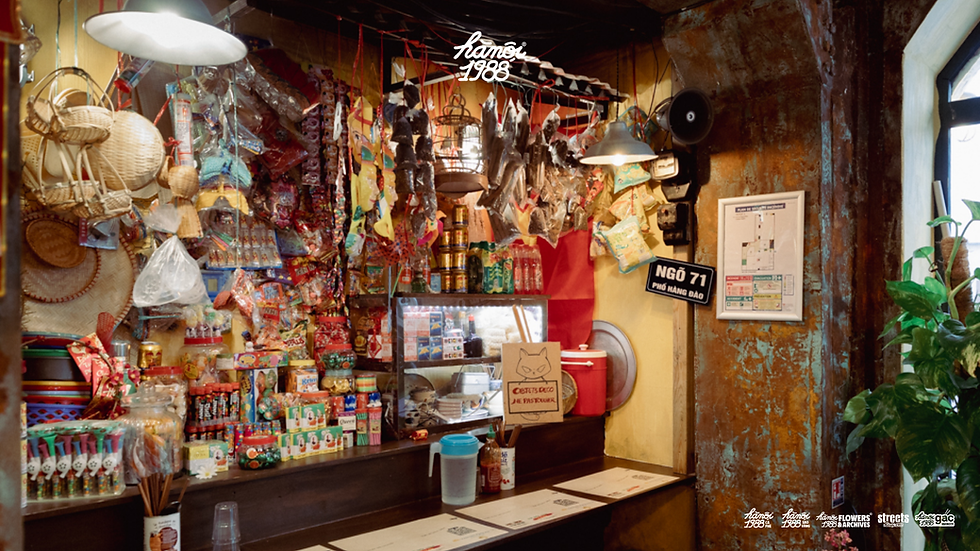
Hanoi 1988 Sao Vàng - 16 Rue le Regrattier, 75004 Paris On Île Saint-Louis, this is where pho reaches its most serious expression. The interior is designed after the neighbourhood tea shops of 1980s Hanoi, which is warm, deliberately unhurried. The kitchen here is where the 24-hour broth lives, where the fresh noodles are made each morning, where the Phở Sốt Vang was born. Reservations are recommended.
Hanoi 1988 Cà Phê - 35 Rue Galande, 75005 Paris In the Latin Quarter, a Vietnamese café in the truest sense: Vietnamese drip coffee, egg coffee, and the gentle ritual of drinking slowly in a room that does not rush you. The café that central Paris was missing.
Flowers & Archives - 51 Rue des Archives, 75003 Paris In Le Marais, the most unexpected address in the group - a coffee lounge, flower shop, ceramics boutique, and workshop space in one. Bat Trang pottery from northern Vietnam alongside handmade cakes and seasonal flowers. Ateliers on bread-making, ceramics, and floral design run regularly. Less a restaurant than a cultural space and one of the most quietly remarkable openings in Parisian F&B in recent years.
Frequently Asked Questions
What is the best Vietnamese dish to try for the first time? Start with pho if you want to understand the depth of Vietnamese cooking. Well-made broth tells you everything about a kitchen's patience and values. Start with bun bo if you prefer something lighter and more immediate. Both are essential. Neither will disappoint at Hanoi 1988.
Is Vietnamese food spicy? Vietnamese food is not inherently spicy in the way that Thai or Sichuan cuisine can be. Heat is present in dipping sauces and in certain preparations, but it is one note among many rather than the dominant one. Most dishes at Hanoi 1988 are accessible to those who prefer mild food, with chilli available on the side for those who want it.
Is Vietnamese food suitable for vegetarians? Yes, with care. The Bún Chay version of the bun bo bowl is fully plant-based, made with tofu and a vegetable-based sauce. It is worth asking about individual dishes, as some sauces and broths are fish sauce-based. The team at Hanoi 1988 is happy to advise.
What is the difference between northern and southern Vietnamese food? Northern Vietnamese cuisine, which the tradition that Hanoi 1988 draws from, tends to be more restrained: less sweet, less heavily spiced, with a focus on the quality of individual ingredients and the precision of the broth or sauce. Southern Vietnamese food is generally bolder, sweeter, and more herbaceous. Both traditions are worth exploring. Hanoi 1988 is a reliable guide to the north.
Do I need a reservation? For Hanoi 1988 Sao Vàng, reservations are strongly recommended because the dining room is small and fills quickly, particularly at weekend lunchtimes. The Quai des Orfèvres address is larger and more flexible. The Ca Phê and Flowers & Archives concepts welcome walk-ins.
Looking for one of the best Vietnamese food restaurants in town? Hanoi 1988 operates across four addresses in central Paris: 72 Quai des Orfèvres (1st arr.), 16 Rue le Regrattier (4th arr.), 35 Rue Galande (5th arr.), and 51 Rue des Archives (3rd arr.). Full menus and reservations at viet-eat.com.


Comments